
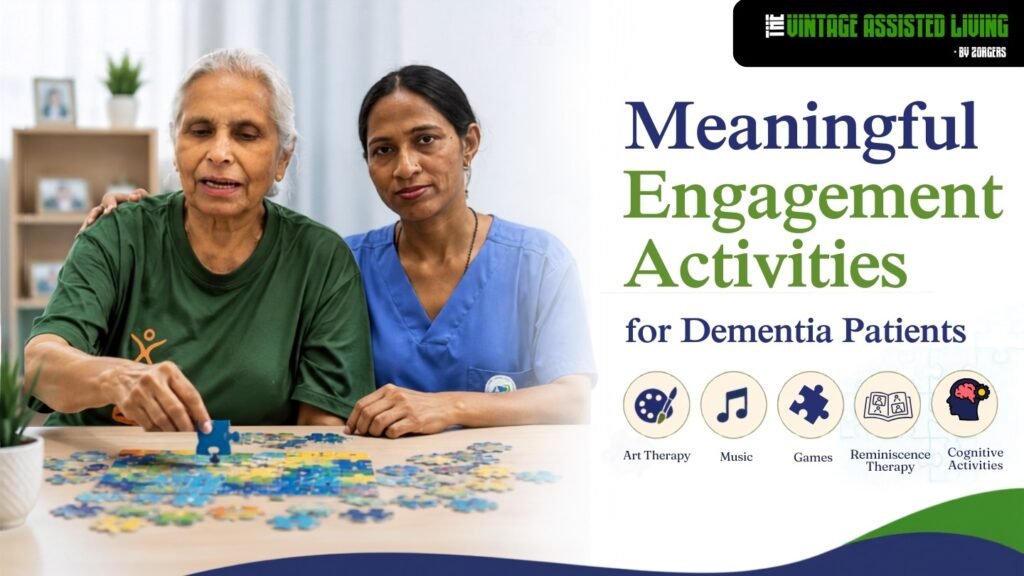
Quick Answer: There isn’t one “right” activity for dementia – there are eight broad ones that actually make a difference: reminiscence, music, art, exercise, cognitive games, gardening, social time, and spiritual or relaxation practices. Each one reaches a different part of what dementia leaves behind old memories, rhythm, movement, touch, emotion. A good care plan doesn’t pick one and stick to it. It rotates through all eight, depending on the day.
Table of Contents
- Why Engagement Actually Matters
- 1. Reminiscence Therapy (Memory-Based Activities)
- 2. Music Therapy
- 3. Art & Creative Activities
- 4. Physical Activities & Exercise
- 5. Games & Cognitive Activities
- 6. Gardening Activities
- 7. Social Engagement Activities
- 8. Spiritual & Relaxation Activities
- Matching Activities to Dementia Stage
- How The Vintage Club Structures Engagement
- Frequently Asked Questions
Why Engagement Actually Matters
Dementia takes away memory, language, and reasoning but it doesn’t take away the need to feel useful, connected, or comfortable. And that’s really the gap most families don’t expect: it’s not the big medical decisions that wear a caregiver down, it’s the long, empty stretches of the day. That’s usually when the agitation shows up, or the same question gets asked for the tenth time.
The activities below aren’t about “keeping busy” for its own sake. Done consistently, they’ve been shown to reduce agitation and anxiety, improve sleep, and slow the pace of functional decline often more reliably than medication alone.
1. Reminiscence Therapy (Memory-Based Activities)
Old memories tend to outlast recent ones in dementia, which is exactly why reminiscence works as well as it does. It’s not about testing what someone remembers it’s about giving them a way back into who they are.
- Flipping through old family photographs and talking about the people or the place not quizzing on names or dates
- Holding onto something nostalgic: an old radio, a wedding album, a utensil from the kitchen they once ran
- Asking open questions like “tell me about Diwali at your house” instead of closed ones that put pressure on recall
- A small memory box of personal objects they can pick up and talk through
The reason this works isn’t a coincidence long-term and procedural memory hold up much longer than short-term memory in dementia, so reminiscence is reaching for something that’s actually still there.
2. Music Therapy
Of everything dementia touches, music seems to be one of the last things it reaches, because musical memory lives in a different part of the brain than facts and dates do.
- Old devotional songs, Bollywood classics, or regional folk music from their younger years
- Clapping or tapping along to a rhythm singing isn’t required
- A tambourine or a small bell for something to hold and use
- Group singing, which doubles as low-pressure social time
Caregivers see this more often than you’d expect a resident who hasn’t spoken in weeks will hum along the moment a familiar tune starts playing.
3. Art & Creative Activities
What makes art work for dementia patients is exactly what makes it work for anyone anxious about “getting it wrong” there’s no wrong answer here.
- Coloring with simple, large patterns
- Painting with big brushes and bold colors
- Collage work with fabric, paper, or things collected from outside
- Working with clay or dough mostly for the feel of it
Take away the fear of failing, and a lot of residents who’ve withdrawn from other activities will still pick up a paintbrush.
4. Physical Activities & Exercise
Movement does more than keep the body active it changes how the rest of the day goes. Residents who move a little during the day tend to sleep better and get restless less often as evening sets in.
- Short, supervised walks indoors or in a garden
- Seated stretches or chair yoga
- A simple game of balloon toss or beanbags
- Dancing to familiar music, seated or standing with support
This is one of the more consistently effective non-drug ways to reduce agitation it works with the body’s own rhythm rather than against it.
5. Games & Cognitive Activities
The trick with games is pitching them just below what the person can still do enough to hold attention, not enough to feel like a test.
- Picture bingo instead of number bingo
- Sorting buttons, coins, or cutlery by color or type
- Jigsaw puzzles with large, simple pieces
- Matching pairs of familiar images
Get the difficulty right, and a game stops feeling like an exam and starts feeling like something worth finishing.
6. Gardening Activities
For anyone who spent years around a garden, a kitchen, or a farm, this often lands better than any indoor activity ever could.
- Watering plants
- Potting soil or moving seedlings
- Picking flowers or herbs
- Light weeding or raking, with someone nearby
It brings together smell, sunlight, and touch, along with something a lot of residents miss actually being useful.
7. Social Engagement Activities
Isolation makes everything else worse the memory loss, the mood, the confusion. Even small doses of company push back against that.
- Eating meals together instead of alone
- Passing a ball around in a small group, or a shared music session
- Short, calm visits from family, children, or a pet
- A regular tea or snack time as a small daily anchor
What’s striking is how far this goes even in advanced dementia residents stop recognizing faces long before they stop responding to warmth and tone of voice.
8. Spiritual & Relaxation Activities
These routines were often practiced for decades before dementia ever entered the picture, which is exactly why they still land the comfort doesn’t depend on understanding, just on familiarity.
- Devotional chants, bhajans, or the sound of temple bells
- Guided breathing or simply sitting quietly
- Prayer routines from the person’s own faith, kept exactly as they always were
- Calming scents like sandalwood or jasmine
By the time other routines have faded, this one often hasn’t.
Matching Activities to Dementia Stage
| Stage | Best-Fit Activities (from the 8 above) | Avoid |
|---|---|---|
| Early Stage | Games & cognitive activities, gardening, art, physical exercise, social outings | Tasks so simple they feel condescending |
| Moderate Stage | Music therapy, reminiscence, seated exercise, group social activities | Multi-step instructions, noisy or crowded settings |
| Advanced Stage | Music therapy, spiritual/relaxation activities, gentle touch-based social engagement | Anything needing verbal recall or fine motor precision |
How The Vintage Club Structures Engagement
At The Vintage Club’s dementia and Alzheimer’s care home in Mohali, none of this happens as a one-off “activity hour.” All eight activity types are woven into the daily schedule, and caregivers are trained to notice a resident’s mood in the moment and shift accordingly moving from reminiscence to music, or from a group setting to something quieter, depending on what the day calls for.
This sits alongside broader assisted living support, and works well for residents who also need Parkinson’s care or post-stroke rehabilitation. For families who want structured daytime engagement without full-time residency, the day care center for senior citizens is also worth a look.
Frequently Asked Questions
What are the 8 main types of engagement activities for dementia patients?
Reminiscence therapy, music therapy, art and creative activities, physical exercise, cognitive games, gardening, social engagement, and spiritual or relaxation activities.
Which activity works best for dementia patients who no longer speak?
Music therapy and spiritual or relaxation activities tend to work best, since they rely on rhythm and repetition rather than language or memory.
How long should an engagement activity last?
Usually 10 to 20 minutes is the sweet spot. Watch for signs of tiredness or frustration, and stop before it turns into a bad experience.
Can these activities reduce aggression or agitation in dementia?
Yes, music therapy, physical exercise, and social engagement in particular are among the most effective non-drug ways to ease agitation and sundowning.
Should activities be done alone or in a group?
Both matter. Group activities build connection, while things like reminiscence or art often work better one-on-one, where you can read the person’s mood more closely.
Is it necessary to correct a dementia patient during reminiscence activities?
No, correcting facts usually just causes distress. The point isn’t accuracy, it’s the feeling the memory brings up.
Talk to The Vintage Club
For a personalized daily engagement plan for a loved one with dementia, reach The Vintage Club at +91-73470-03707 or WhatsApp +91 70876 02000, or visit our contact page.

