
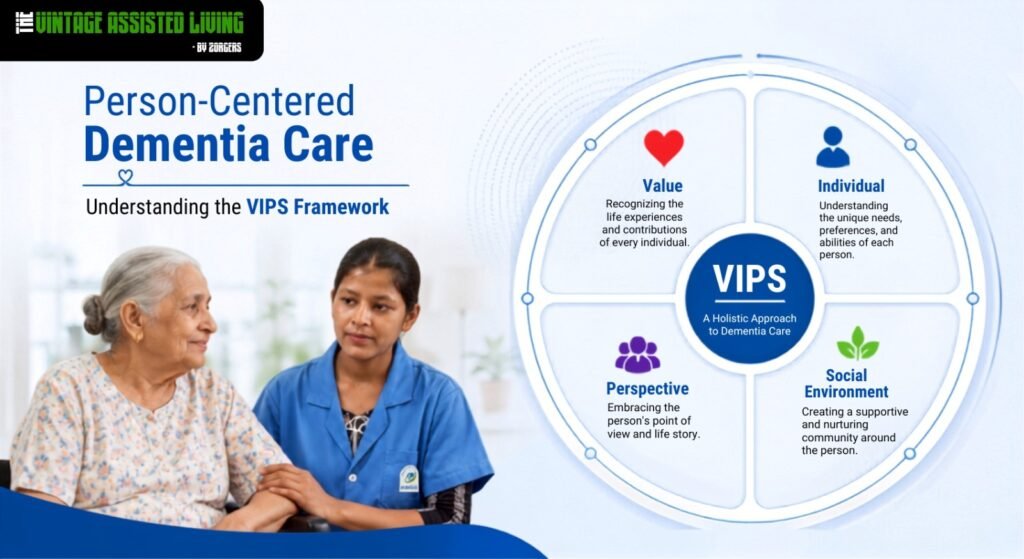
If you’ve ever sat with a parent or grandparent who has dementia and felt like the “care plan” on paper didn’t quite capture who they actually are you’re not alone. That gap is exactly what the VIPS framework was built to close.
Developed by dementia care researcher Tom Kitwood, VIPS gives caregivers a simple way to remember what person-centered care means in practice: Valuing the person, treating them as an Individual, seeing things from their Perspective, and building a Social environment where they can still feel like themselves. It’s less about managing symptoms and more about protecting the person underneath them.
What Do We Actually Mean by “Person-Centered” Care?
Here’s the honest version: a lot of dementia care ends up organized around the disease medication schedules, safety checks, behaviour logs. All necessary, but none of it answers the question that matters most to families: is this still the person I know?
Person-centered care flips the starting question. Instead of “how do we manage this behaviour,” it asks “what is this person trying to tell us, and what do they need right now?” Because even when memory fades, the emotional core doesn’t people with dementia still feel pride, fear, comfort, and joy, sometimes more intensely than before, simply because they can’t always put it into words anymore.
Breaking Down the VIPS Framework
Tom Kitwood introduced this idea, and dementia care specialist Dawn Brooker later shaped it into the four-part structure care teams use today.
V – Valuing
This starts with something deceptively simple: talking to the resident, not about them, even in later stages when conversations get harder. It means still offering choices what to wear, what to eat, when to nap – instead of deciding everything on the person’s behalf. And it extends to the staff too. Caregivers who feel valued and well-trained tend to bring more patience and consistency to residents.
I – Individualized
No two people experience dementia the same way, so no two care plans should look identical either. A good caregiver learns what someone did for a living, what music they loved, which foods bring comfort, and adjusts communication style accordingly. Some residents respond better to a gentle touch, others to a familiar song or an old photograph.
P – Perspective
This is the hardest one, and arguably the most important. If a resident insists it’s time to “pick up the kids from school,” the instinct is to correct them. But that moment is often less about the fact and more about the feeling behind it purpose, love, routine. Responding to that feeling, rather than arguing the facts, tends to work far better.
S – Social Psychology
Kitwood’s research found something that should probably get more attention than it does: a poor social environment can make dementia symptoms worse, independent of the disease itself. Rushing someone, talking over them, or treating them like a child all add distress on top of what they’re already navigating. A calm environment, familiar caregivers, and activities matched to what someone can still enjoy make a measurable difference.
What This Looks Like in an Actual Day
Frameworks are easy to write down and harder to live out, so here’s what VIPS looks like applied to ordinary moments because most of a person’s day with dementia isn’t a medical event, it’s just a day.
- Meals aren’t rushed. Preferences and pacing matter more than finishing on schedule.
- Bathing and dressing come with explanations and choices at each step, not just efficiency.
- Sleep follows the person’s natural rhythm rather than a facility’s fixed timetable.
- Social time is built around what someone has always loved music, gardening, conversation, whatever it is.
- Distress gets met with reassurance and presence first, before anything else.
How The Vintage Club Puts This Into Practice
At The Vintage Club’s dementia and Alzheimer’s care home in Mohali, VIPS isn’t a poster on the wall it shapes how the day is actually structured. Every resident has a life-history profile that caregivers actually use, staff are trained specifically in dementia communication, and routines stay calm and familiar rather than rigid.
This sits alongside the facility’s broader assisted living services and day care programs for senior citizens, so families have somewhere to turn as care needs change over time. If you’re weighing options for a loved one, reach out to The Vintage Club a conversation costs nothing, and individualized care planning starts with understanding your specific situation.
Questions Families Often Ask
What does VIPS actually stand for?
Valuing the person, treating them as an Individual, understanding their Perspective, and providing a supportive Social environment. Tom Kitwood developed the framework; Dawn Brooker later refined it into this four-part structure.
Who came up with this approach?
Tom Kitwood, a psychologist whose work on personhood in dementia reshaped how care providers think about the disease moving the focus from symptoms to the whole person.
Does person-centered care actually make a difference?
Yes, it tends to preserve dignity and reduce distress, which in turn improves quality of life. It doesn’t replace medical care; it works alongside it.
How is this different from a “standard” care approach?
Standard care often leans on generic protocols built around safety and symptom management. VIPS-based care builds each interaction around the individual their history, their perspective, their emotional state without dropping the medical fundamentals.
Can families do this at home, without a care facility?
Absolutely. The core of VIPS valuing the person, learning their history, seeing their perspective, keeping the environment calm works whether care happens at home or in a residential setting. It’s more mindset than infrastructure.
What type of dementia patients does the VIPS framework work for?
The VIPS framework works for every stage whether it’s early-stage or advanced dementia. The approach adjusts somewhat depending on the stage, but the core principle stays the same: seeing the person before their disease.
How long does it take for caregivers to learn the VIPS approach?
It’s a continuous learning process, not a one-day training. The basic principles are quick to grasp, but learning each resident’s individual history and perspective takes time which is why consistent caregivers tend to be more effective than new ones.
Is the VIPS framework only useful for dementia, or does it apply to other conditions too?
Kitwood developed this framework specifically for dementia care, but its underlying principles valuing the individual, understanding their perspective can also be applied to conditions like Parkinson’s, stroke recovery, and general elderly care.

